De nombreux acheteurs et marques remarquent un phénomène lors des inspections : une même bouteille en verre peut avoir une paroi épaisse d’un côté et mince de l’autre. C’est parfois difficile à voir à l’œil nu, mais le fait de faire passer une lumière à travers la bouteille ou de la peser rend le problème évident. Une épaisseur de paroi irrégulière ne concerne pas seulement l’apparence : elle affecte directement la sécurité du remplissage, le taux de casse pendant le transport et la sensation procurée par le produit final.
Premièrement, le risque de casse augmente.Si certaines parties de la bouteille sont trop fines, des points faibles peuvent apparaître. Lors du remplissage sous pression, des changements de température, de longs trajets maritimes avec des secousses et l’empilage, ces zones sont susceptibles de se fissurer. Même si aucun problème n’apparaît lors des contrôles en usine, des dommages dans l’entrepôt d’un client ou sur le marché peuvent toujours entraîner une perte de matériaux et nuire à l’image de la marque.
Deuxièmement, cela peut provoquer des différences de couleur visibles après le remplissage.Lorsque vous versez des sérums transparents, des lotions toniques ou d’autres liquides clairs, la lumière traversant la bouteille peut faire ressortir les différences d’épaisseur, entraînant une luminosité et une couleur inégales à certains endroits. Cela peut sérieusement diminuer la sensation haut de gamme des produits de soins de la peau de luxe. Ce problème est difficile à remarquer avec des bouteilles vides ; il ne devient visible qu’après le remplissage.
Troisièmement, cela affecte les processus ultérieurs de traitement de surface.Le sablage, la pulvérisation, la galvanoplastie et d’autres traitements de surface nécessitent tous que la bouteille chauffe de manière uniforme, mais les différences d’épaisseur de paroi font que différentes parties de la bouteille absorbent et libèrent la chaleur à des vitesses différentes : les zones fines chauffent rapidement et les zones épaisses chauffent lentement. Cela peut entraîner des couleurs de pulvérisation irrégulières, des effets de sablage incohérents et des problèmes tels qu’une mauvaise adhérence du revêtement, un écaillage de la peinture ou des marbrures localisées.
Quatrièmement, cela interfère avec l’étanchéité et l’ajustement lors de l’assemblage.Les variations d’épaisseur de paroi peuvent légèrement affecter l’alignement vertical du corps de la bouteille, ce qui dégrade indirectement la coaxialité du col de la bouteille. Lors de l’assemblage ultérieur de la pompe ou du compte-gouttes, cela peut les faire se tordre de manière anormale ou s’incliner, et dans les cas extrêmes, augmenter le risque de fuite. En même temps, le poids des bouteilles individuelles peut davantage varier, avec des différences de poids visibles entre les bouteilles d’un même lot.
Cinquièmement, cela rend le recuit plus difficile.Plus la différence d’épaisseur de paroi est importante, plus il est difficile d’éliminer les contraintes internes résiduelles dans le verre pendant le refroidissement. Même après le recuit, des contraintes peuvent encore subsister aux endroits où les parties épaisses et fines se rejoignent, augmentant le risque que le verre se brise spontanément pendant le stockage et le transport.
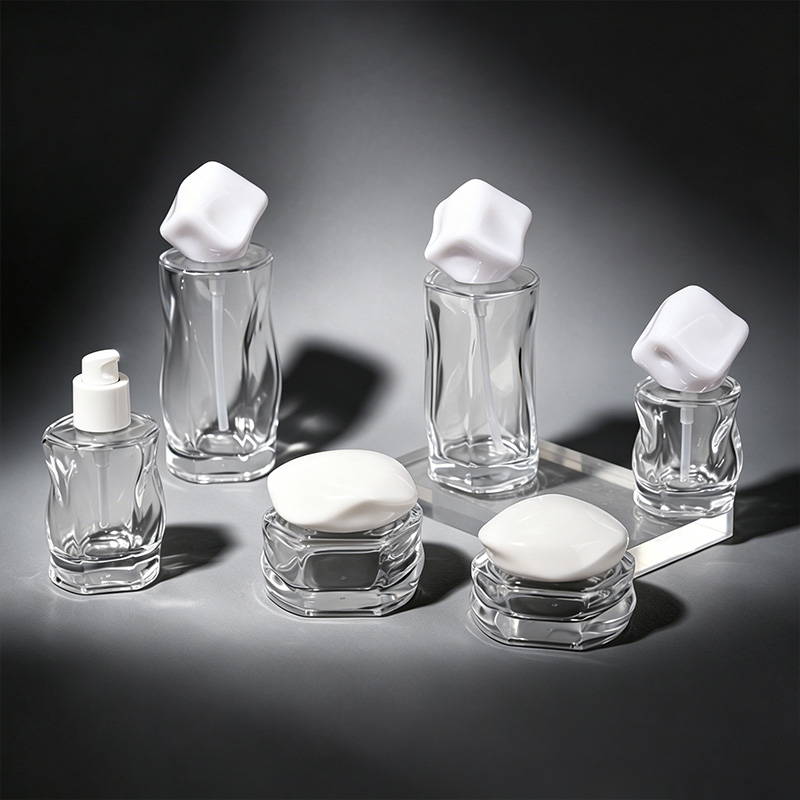
Contrôle standard de l’industrie pour lesbouteilles en verre cosmétiques : la différence d’épaisseur de paroi pour une même bouteille est recommandée à moins de 0,2-0,3 mm. Les bouteilles personnalisées haut de gamme ont des exigences encore plus strictes. De légers écarts sont acceptables dans le processus de fabrication ; si l’épaisseur varie fortement et que les zones fines sont manifestement trop minces, le produit est considéré comme défectueux et doit être mis au rebut.
Les excellentes usines évitent ces problèmes par plusieurs moyens : calibrer l’endroit où le matériau tombe, maintenir une pression d’air stable, contrôler la différence de température du moule, inspecter complètement l’épaisseur de paroi de la première pièce et effectuer en continu des échantillonnages pour le polissage et des mesures au pied à coulisse pendant la production de masse.
Si vous choisissez un emballage en verre pour des produits de soins de la peau et que vous avez des questions sur l’épaisseur de paroi ou le contrôle qualité, n’hésitez pas à discuter avec moi à tout moment.